For many people, Ada was the first step toward making sense of their health. The assessment guided them through their symptoms and offered clarity on what might be going on. But at the very moment when motivation to act was strongest, the experience stopped short and they were left to navigate a fragmented healthcare system on their own.
This was more than just a usability issue. It was a gap in Ada’s promise to support people across their health journey. To close it, we needed to extend beyond advice into diagnostic testing. Yet building an in-house laboratory network in the highly regulated US market would take years of investment and expertise.
The challenge became clear: how could we help users move seamlessly from understanding their symptoms to taking meaningful action—without slowing down innovation or breaking user trust?
Solution
Making Diagnostic Testing Accessible Within the Ada Experience
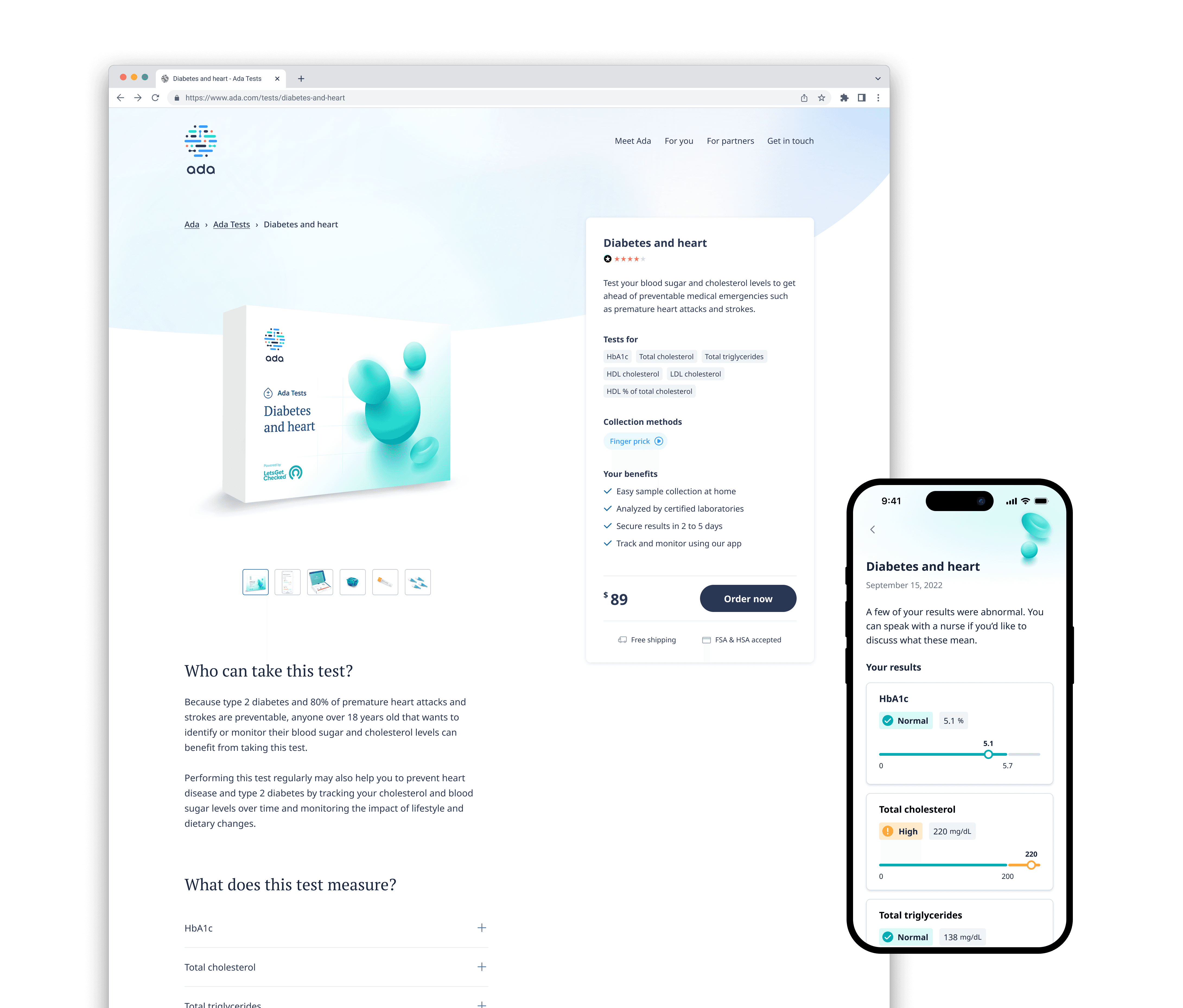
We introduced Ada Tests, an at-home testing service that allowed users to take action immediately after their assessment. By partnering with a trusted US provider, we could deliver diagnostics quickly and reliably, while keeping the experience fully integrated into Ada. The MVP focused on creating a smooth journey from test ordering to result delivery, while also laying the groundwork for a connected health profile through Ada ID.
Shopping for Test Kits
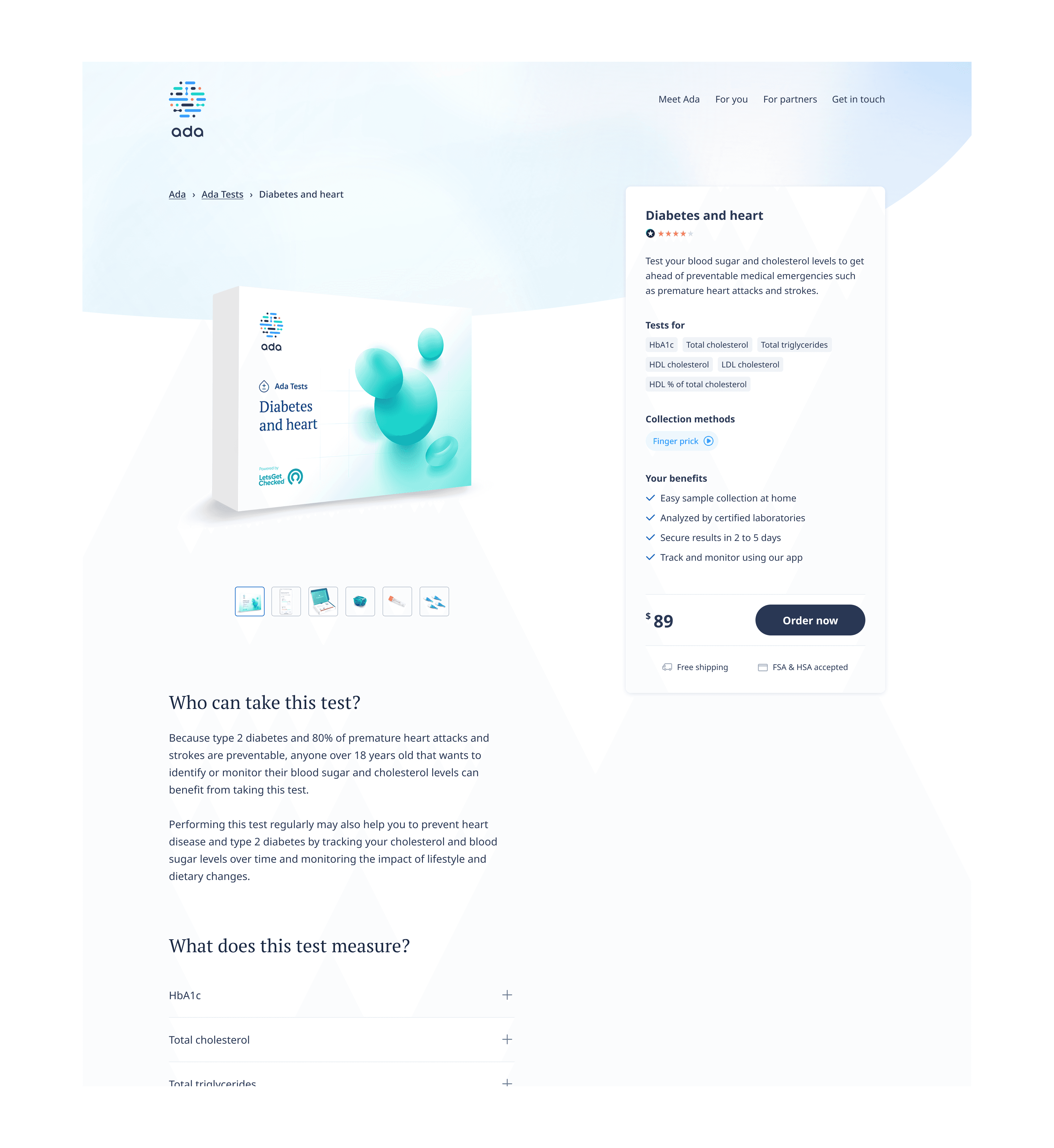
We created a dedicated online shop where users could browse a variety of test kits, from diabetes to sexual health and hormone panels. The shop was designed to feel simple and approachable, with clear product information and guidance, making it easy for users to select the test most relevant to their needs.
Streamlined Ordering Process
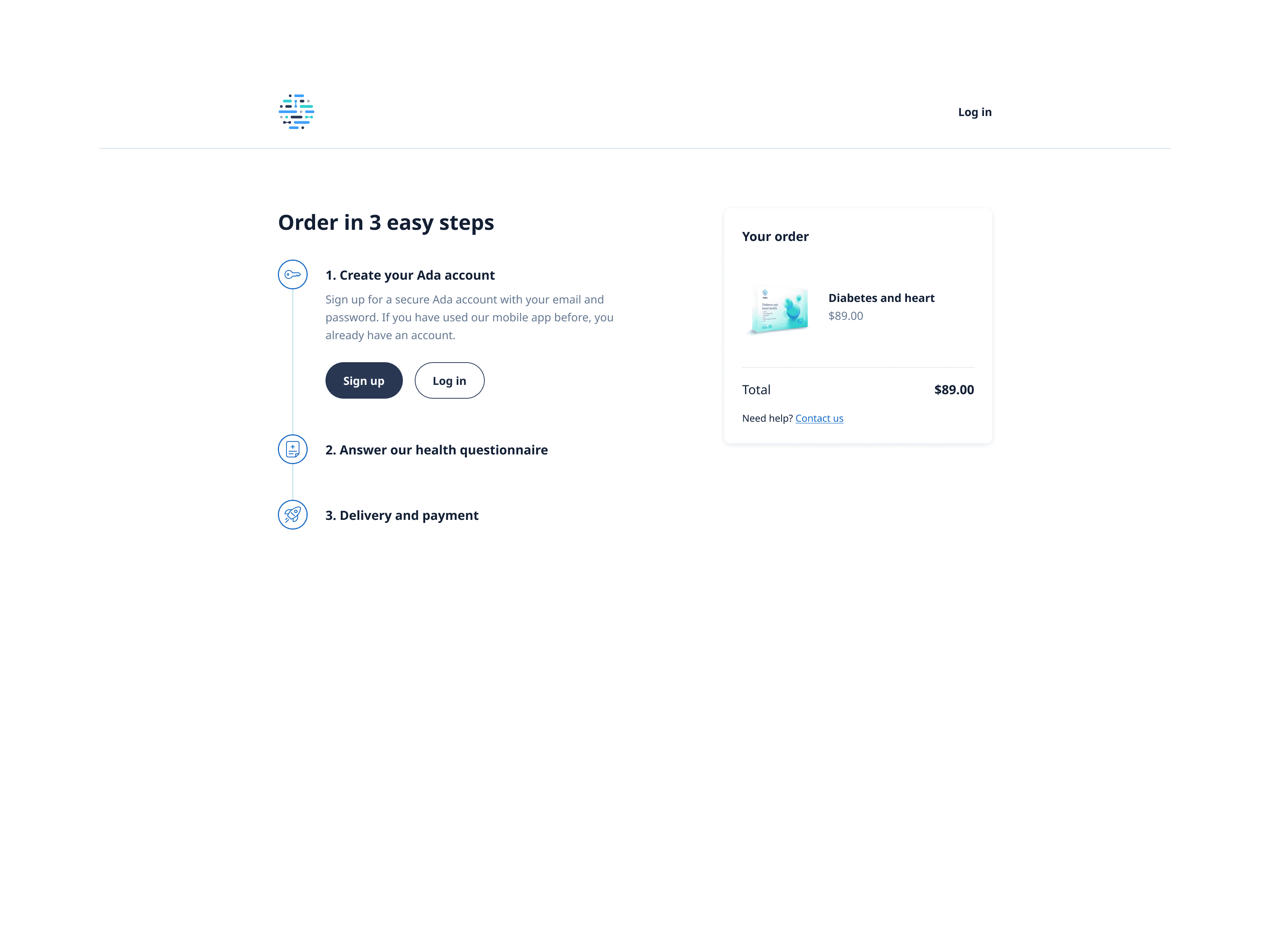
Purchasing a test kit involved a clear, three-step flow: signing up or logging in, completing a health questionnaire, and finishing payment and delivery details through Shopify. This structure balanced compliance requirements with a smooth user experience, reducing friction at a critical step where drop-off could easily occur.

Viewing Results in the App
Once lab results were ready, users received a notification and could access them directly in the Ada app. The experience was designed for clarity: a simple summary on the landing page, followed by detailed biomarker results. Users also had the option to call a nurse for support, ensuring results were understandable and actionable.
Ada ID as the Foundation
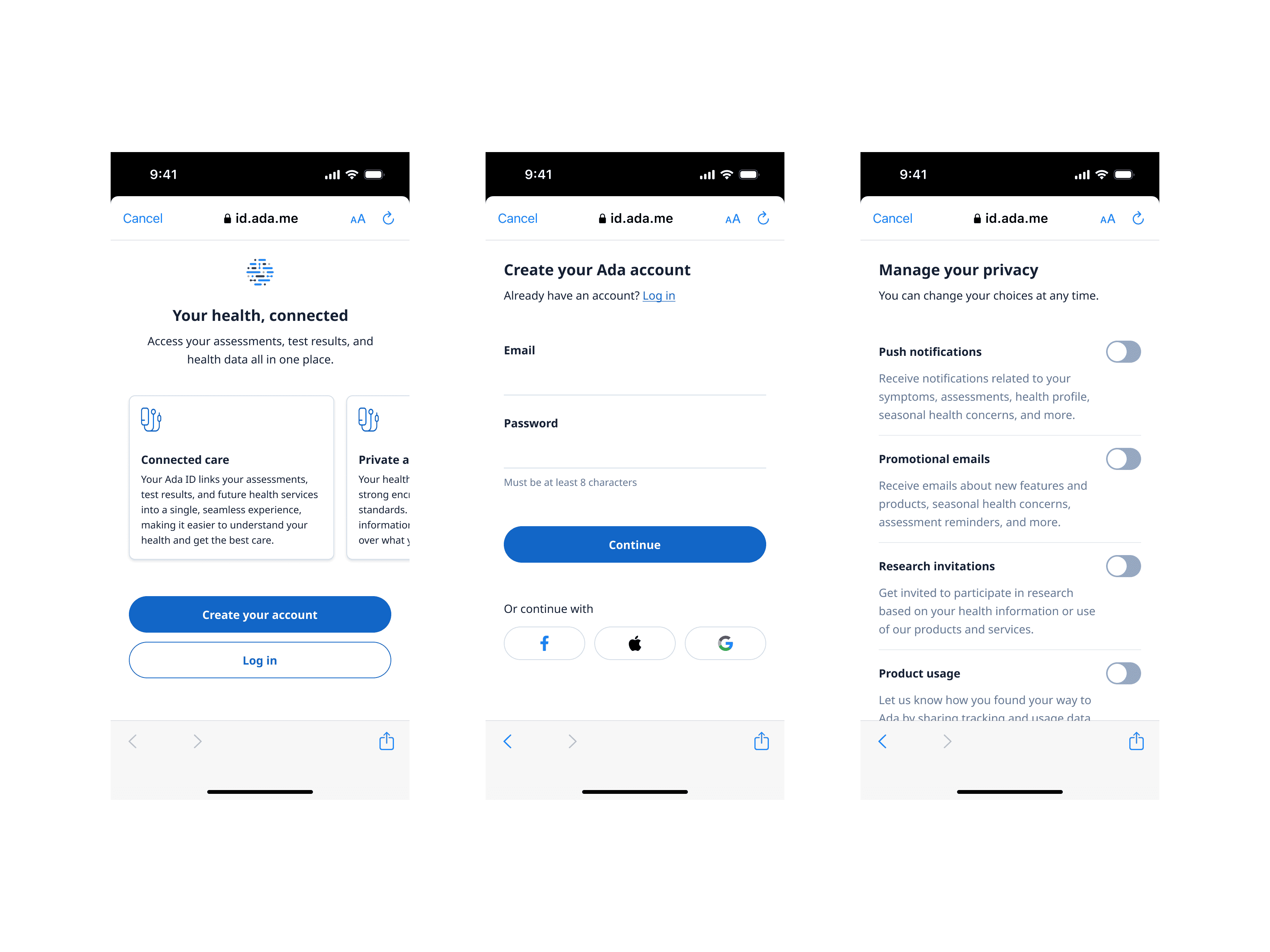
To enable secure access to test ordering and results, we introduced Ada ID — a unified account system for our users. Beyond authentication, this was a crucial step towards building a connected health profile across Ada’s services. By laying this foundation, we ensured the MVP was not only functional but also a strategic investment in Ada’s future.
Result
Delivering a Functional Diagnostic Experience
Ada Tests launched in 2022 as an MVP to make at-home diagnostic testing accessible directly within the Ada experience. The service successfully enabled users to browse, order, and receive test kits, then view their results in the mobile app. Hundreds of users completed the full journey, and the MVP delivered a reliable, usable experience without major issues.
Although the service was discontinued in 2024 due to a refocus of company priorities, feedback from users was positive. Customers highlighted the clarity of the results, the ease of the ordering process, and the seamless integration with the Ada app. Even in its limited form, the service demonstrated that integrating diagnostics into a digital health ecosystem was both feasible and valued by users.
Beyond the immediate MVP, Ada Tests provided a foundation for future initiatives. Components like Ada ID and the scalable results visualization continue to inform other Ada services, showing how thoughtful design decisions can create reusable patterns and lasting value beyond a single product release.
Design Decisions
Designing a Trusted At-Home Testing Experience
Launching Ada Tests required balancing new capabilities with existing design patterns and user expectations. Every decision was focused on usability, trust, and consistency, while establishing a foundation for a scalable, future-ready service. From web shop design to results visualization and Ada ID onboarding, each choice reflected a thoughtful approach to delivering clarity and confidence to users.
Bringing E-Commerce to Ada
Ada’s website had traditionally been purely informational, so introducing a web shop meant venturing into e-commerce for the first time. We applied e-commerce best practices to create an intuitive browsing and ordering experience, while preserving Ada’s approachable tone. Navigation, layout, and micro-interactions were carefully designed to feel familiar yet functional, ensuring that users could explore, select, and purchase test kits quickly and confidently, even in a context new to the brand.
Harmonizing Web and App Design
With Ada Tests, users started their journey on the web and completed it in the mobile app — a handoff that made consistency even more important. Historically, Ada’s website and app carried slightly different looks and tones, but this project created an opportunity to close that gap. By working closely with our Brand team, we refined the copy and visual design so the transition between web and mobile felt seamless. This alignment not only built user confidence in a sensitive context like medical testing, but also set a stronger foundation for future cross-channel initiatives.
Ada ID Onboarding and User Trust
The onboarding screen for Ada ID had to communicate the initiative’s value clearly. I highlighted USPs like Connected Care, Data Safety, and Privacy, ensuring users understood the benefits of creating an account. While social login options (Apple, Google, Facebook) were available, I deliberately deprioritized them to reduce privacy concerns and build trust, encouraging users to register directly with Ada. This approach balanced accessibility, security, and user perception while supporting the long-term vision of a unified health profile.
Guiding Users Through Multi-Step Ordering
The Ada Tests ordering journey involved several “side-quests” — signing up, completing a health questionnaire, and processing payment through Shopify. To prevent users from losing their place, we consolidated these steps on a single page with a clear three-step structure. Progress was saved, allowing users to return later and continue where they left off, keeping the multi-step process coherent, manageable, and predictable even within a complex, multi-channel MVP.
Scalable and Calm Results Visualization
We designed a clear and consistent way to present lab results that could also be reused across other services, such as risk assessments. The visualization emphasized readability and avoided alarmist colors or messaging, helping users interpret their results calmly. This consistent approach made biomarker information easier to understand, reinforced confidence in the service, and created a foundation for future cross-service data visualization patterns within Ada.
Closing Thoughts
Working on Ada Tests was a unique opportunity to explore how digital health and at-home diagnostics could come together in a seamless, trusted experience. Even as an MVP, it was rewarding to see hundreds of users complete the journey, from ordering a test to viewing results in the app, and know that our design choices had a real impact.
The project also challenged me to think carefully about cross-channel experiences, trust in white-labeled services, and how to communicate sensitive health information clearly. While the service was eventually discontinued, I’m proud of the design foundations we built — Ada ID, results visualization, and the content strategy — which continue to inform other products and serve as reusable patterns for future initiatives.
Ada Tests reminded me how important it is to balance ambition with focus, and how even a limited MVP can leave a meaningful footprint for both users and the product team.